
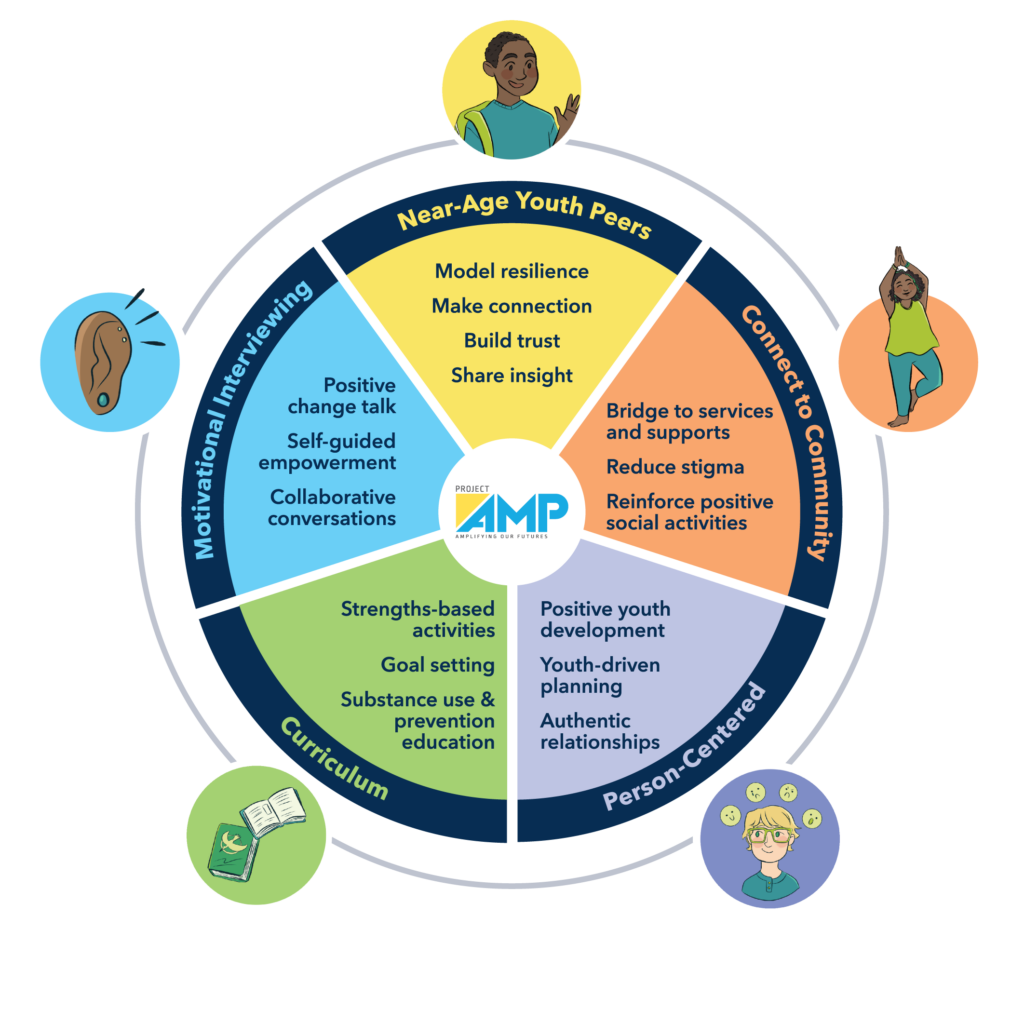
Project Amp is an innovative prevention and early intervention model for adolescents in community and school settings. It is designed to prevent and delay substance use by decreasing risk factors and strengthening protective factors. Project Amp is delivered by near-age youth peers across four to eight sessions and has five core elements:
- Near-age youth peers draw on lived/living experience to model resilience, make connection, and build trust with adolescents.
- Motivational Interviewing promotes positive change talk, self-guided empowerment, and collaborative conversations to support youth to take action steps toward wellness.
- Person-centered approaches promote youth-driven programming, positive youth development, and authentic relationships.
- Strengths-based, interactive activities prioritize goal setting, self-exploration, and substance use and prevention education.
- Positive social activities and community connections
Studying Project Amp’s Outcomes
Methods
From June 2021 to December 2024, the Massachusetts Department of Public Health supported implementation of Project Amp across 18 school-, community-, and clinic-based sites in Massachusetts. At the beginning of the program and six months after its end, youth were asked to self-report outcomes related to mental health, stress management, peer relationships and social settings, and perception of harm of substances.
Sample
The sample population consisted of 578 adolescents with an average age of 15, the majority of whom (80.8%) were 14–17 years of age. Over a third (37.4%) identified as White/non-Hispanic/non-Latinx, 10.9% as Black/African American, 2.6% as Asian, 2.3% as multi-racial, and 33.4% as Hispanic/Latinx/e. A third (32.2%) identified as LGBTQ+. Almost two-thirds (61%) reported having experienced trauma, and 49.7% had experienced school discipline in the past year.
Findings
The assessment included items on stress and mental health, social connectedness, self-efficacy, perception of harm of substances, resistance to peer influence, and coping mechanisms. Assessment questions borrow from standardized instruments. Findings include:
–Stress levels significantly decreased in overall sample (p<.01)
–Anxiety levels significantly decreased in overall sample (p<.05)
–Depression levels did not reduce in overall sample, but there were significant reductions in the following sub-groups: LGBTQ+ (p<.05), including nonbinary and genderqueer (p<.01)
–Coping mechanisms significantly increased in overall sample (p<.01)
–Social connectedness increased in overall sample (p<.01)
–Self-efficacy score increased in overall sample (p<.01)
–Risk-taking behaviors decreased in overall sample (p<.05)
–Perception of harm of electronic nicotine products (vapes or e-cigs) increased in overall sample (p<.05)
–Older youth (p<.01) and Hispanic/Latinx youth (p<.05) had increased perception of harm of marijuana
–Younger adolescents (aged 10-13) (p<.01), bisexual youth (p<.05) and LGBTQ+ youth (p<.01) had increased perception of harm of narcotics; LGBTQ+ youth had increased perception of harm of prescription stimulants (p<.05)
Discussion
Youth who completed Project Amp had increases in protective factors and decreases in risk factors that are linked to the the prevention and delay of initiation of substance use. With a structured yet flexible curriculum, near-age youth peers create safe opportunities for adolescents to explore goals related to substance use and well-being in school and community settings.
Learn More
To learn more about Project Amp and other near-age youth peer models, visit c4innovates.com/project-amp or reach out directly to projectamp4youth@c4innovates.com.